Library › 10. Philosophy › Kempō Hakku
The Kempō Hakku (拳法八句, “the eight precepts of the fist”) is a poem from the Bubishi. Its third line gave Gōjū-Ryū its name.
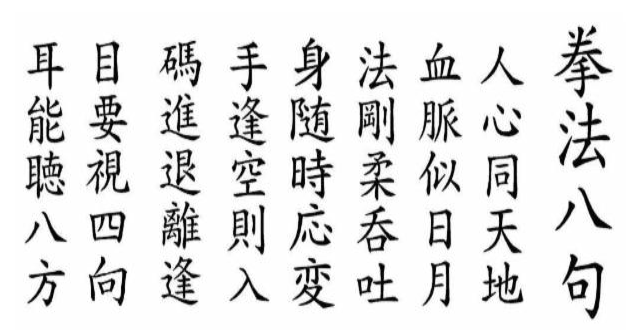
1. 人心同天地 – Jinshin wa Tenchi ni Onaji
The soul is one with heaven and earth.
The philosophical approach matches that of Bunbu Ryōdō (the way of the sword and the brush). In the martial arts, the dual concept is everywhere. Training covers the physical (earth) and the mental level (heaven). Balancing these aspects is essential.
2. 血脈似日月 – Ketsumyaku wa Nichigetsu ni Nitari
The cycle of the body is like that of sun and moon.
Sun and moon are in constant alternation. Likewise, the fluids of the body flow without pause. The allegory expresses the Daoist principle of eternal, constant flow. Movement, breathing, training, adapting, changing – all of it should follow this idea. Every action is followed by the next. When something ends, something begins.
3. 法剛柔呑吐 – Hou wa Goju wo Donto Su
Everything in the universe breathes hard and soft.
Inhaling is soft, exhaling is hard. Pulling techniques are soft, thrusting techniques are hard. Receiving/blocking needs soft flexibility. Striking and punching techniques need power and hardness. In the same way, be hard on oneself in order to become gentle towards others. This refers to the way of training with oneself. The goal of training is a good heart.
4. 身随時應変 – Mi wa Toki ni Shitagai Hen ni Ozu
Adapting to constant change.
Improvise, adapt, overcome. The survival slogan applies to every level of training. In a fight, whether friendly or in self-defence, the ability to react and adapt is fundamental. Training should produce the skill to steer body and mind consciously, so as to respond appropriately to unforeseeable situations.
5. 手逢空則入 – Te wa Ku ni Ai Sunawachi Hairu
True technique reveals itself in the absence of conscious thought.
Training aims to write the movements into the body. Muscle memory takes years of constant training. The empty mind (Mushin) or Bruce Lee’s “Be water, my friend” point to the same concept. In a dangerous situation, a calm mind is essential – and so is a body that knows how to react.
6. 碼進退離逢 – Shin Tai wa Hakarite Riho Su
Distance (Maai) and posture (Kamae) decide the outcome of every situation.
Like the feet, which must meet and part, an understanding of centre of gravity, posture and distance is necessary. Open hands and confident body language have a de-escalating effect.
7. 目要視四向 – Me wa Shihou wo Miru wo Yo Su
The eyes look in all directions.
See what is not visible. Recognise patterns. Avoid dangerous situations. React when necessary. The goal: reading body language correctly.
8. 耳能聴八方 – Mimi wa Yoku Happo wo Kiku
The ears hear in all 8 directions.
Expect the unexpected. Awareness must come through all the senses – not only towards potential opponents; the space itself must be perceived too.
Sources
- Patrick McCarthy: Bubishi. The Classic Manual of Combat. Tuttle Publishing, Tokio 1995.
- Gankaku Team Hungary: Bubishi – The Eight Laws of the Fist / Kempo Hakku (Kanji und Romaji)
- Seikichi Toguchi: Okinawan Goju-Ryu. Black Belt Communications, Burbank 1976, S. 14, ISBN 978-0-89750-018-0.
- Morio Higaonna: The History of Karate. Okinawan Goju Ryu. Dragon Books, Isleworth 2001, S. 67–68, ISBN 0-946062-36-6.