Library › 11. Physics in karate › Momentum and impulse
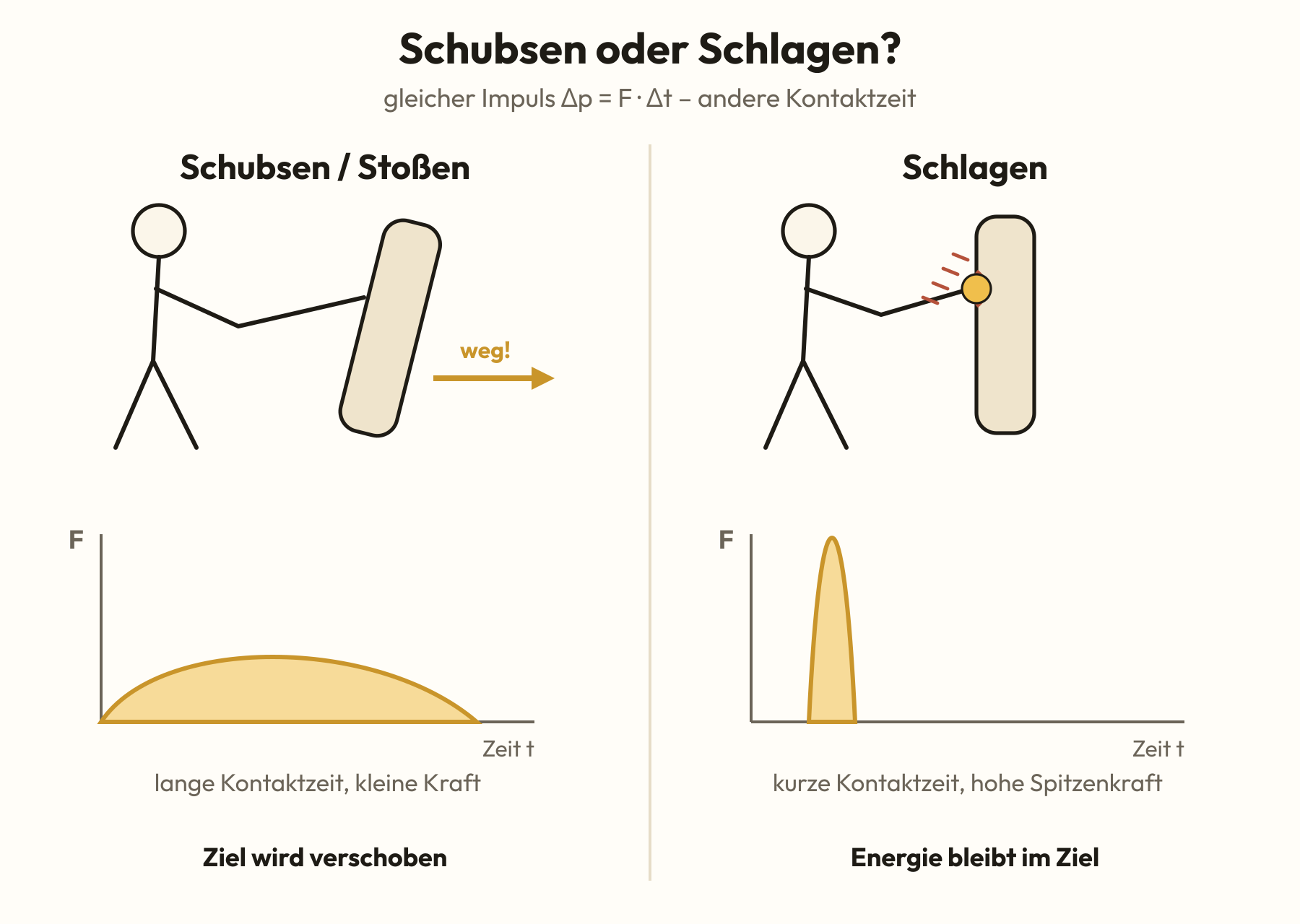
Nobody stops a freight train moving at walking pace. Nor a rifle bullet. Both carry punch – in physics it is called momentum: mass times velocity, p = m · v (unit kg·m/s). Momentum can only be changed by a force acting over a certain time. This quantity is called impulse: Δp = F · Δt.
And now the crucial part: the same momentum, delivered in a shorter time, produces more force – F = Δp / Δt. Short and hard beats long and soft. Every time.
Pushing versus striking
| Pushing / shoving (long contact time) | Striking (short contact time) | |
|---|---|---|
| Contact time | long, roughly a few tenths of a second | very short, roughly a few hundredths of a second |
| Force curve | low force over a long time | high peak force over a short time |
| Effect | Momentum is transferred to the whole body: the target is displaced or knocked off balance. | Most of the energy stays in the target: deformation and shock to the tissue at the point of impact. |
| Example | Shoving away with both hands, lifting off the feet | Punch with Kime, Uraken, Shutō Uchi |
Worked example
An effective mass of 2 kg hits at 8 m/s and comes to a stop in the target. The momentum transferred is Δp = 2 kg · 8 m/s = 16 kg·m/s.
- Pushing over 0.3 s: F = 16 kg·m/s / 0.3 s ≈ 53 N (average).
- Striking over 0.01 s: F = 16 kg·m/s / 0.01 s = 1600 N (average; the peak force is higher).
Same momentum. Thirty times the force. The whole difference lies in the contact time. Pushing gives the effect away – hitting releases it.
Arm alone or the whole body?
In adults an arm weighs about 5–6 % of body mass (upper arm approx. 2.8 %, forearm approx. 1.6 %, hand approx. 0.6 % according to the anthropometric tables of Dempster and Winter). At 75 kg that is about 4–4.5 kg. A strike from the shoulder brings no more than that into the target. With stance, hips and a braced trunk, more body mass couples in – the effective mass rises.
| Model (75 kg, v = 9 m/s, Δt = 15 ms) | Effective mass | Momentum Δp = m · v | Force F = Δp / Δt | equivalent to the weight of | Factor |
|---|---|---|---|---|---|
| Arm only | 4.5 kg | ≈ 40 kg·m/s | ≈ 2700 N | ≈ 275 kg | 1 |
| Good body connection | 20 kg | 180 kg·m/s | 12,000 N | ≈ 1200 kg | ≈ 4,4 |
| Theoretical: whole body rigid | 75 kg | 675 kg·m/s | 45,000 N | ≈ 4600 kg | ≈ 17 |
The factor is the message: same speed, more coupled mass – many times the effect. The absolute numbers, by contrast, are an upper limit. The body is not a rigid block; joints flex, the fist does not stop instantly, the contact time grows. In Olympic boxers an effective punch mass of only 2.9 kg on average was measured (spread ±2.0 kg) – and still about 3400 N. Getting real body mass into the hit puts the figure well above that. That is exactly what stance, hips and Body tension.
Jab, cross and Tsuki
The jab in boxing: fast, short, almost all arm. Little body weight behind it. It measures distance, disrupts, opens – it prepares, it rarely finishes. The cross or power punch is different: weight shifts from the back to the front leg, the hip turns in, the shoulder follows. More mass couples in, the effect rises.
This helps put the low measured effective mass of around 3 kg into perspective. Walilko and colleagues (2005) measured straight punches by Olympic boxers; how many of them were thrown jab-style cannot be reliably read from the study. Plausible, though: the more a punch comes from the arm, the closer the effective mass is to the arm’s mass, or below it.
The karate Tsuki starts exactly here. Root the stance, engage Gamaku, lock the joints with Chinkuchi on impact – this turns the body into an extension of the fist, not an appendage of the arm. The goal is not the fastest hit but the one with the whole body behind it (see Body tension).
What such forces mean
| Comparison | Force (order of magnitude) | Source / note |
|---|---|---|
| Breaking a pine board (approx. 2 cm) | approx. 500–700 N | Feld, McNair, Wilk 1979: critical force for wood approx. 670 N |
| Breaking a concrete slab | approx. 2500–3100 N | Feld, McNair, Wilk 1979 |
| Karateka fist, peak value | over 3000 N | Feld, McNair, Wilk 1979 (hand speed 10–14 m/s) |
| Straight punch, Olympic boxer | approx. 2000–4700 N (mean 3427 N; middleweight 2625 N, super heavyweight 4345 N) | Walilko et al. 2005 |
| Rib fracture | roughly several thousand newtons* | highly dependent on age, point of impact and area; no fixed threshold |
| “Pressing” for comparison | 1000 N ≈ weight of 100 kg | F = m · g with g ≈ 9.81 m/s² |
Connection to training
- A strike that “pushes on” after impact lengthens the contact time and becomes a shove: the target gives way, the peak force drops.
- A short contact time demands a hard, stable structure at the moment of impact: joints that give way lengthen the contact time (see Body tension).
- Pushing and shoving have their own tasks: creating space, breaking balance, setting up throws.
- Conversely, break-falling (Ukemi) uses the same principle: rolling or slapping out when falling lengthens the time over which the body is braked, and so reduces the force on the body.
All calculated values: simplified examples, not measurements. The body is not a rigid block – real values depend heavily on technique, target and measuring method.
* The threshold for rib fractures is not given consistently in the literature and depends heavily on the type of load and the person; the figure is therefore deliberately vague.
Sources
- Dieter Meschede (Hg.): Gerthsen Physik. Springer, Berlin/Heidelberg (24. Aufl. 2010, ISBN 978-3-642-12893-6; 25. Aufl. 2015).
- Michael S. Feld, Ronald E. McNair, Stephen R. Wilk: The Physics of Karate. Scientific American 240 (4), 1979, S. 150–158
- T. J. Walilko, D. C. Viano, C. A. Bir: Biomechanics of the head for Olympic boxer punches to the face. British Journal of Sports Medicine 39, 2005, S. 710–719
- David A. Winter: Biomechanics and Motor Control of Human Movement. Wiley, Hoboken (Segmentmassen nach Dempster).
← Force and pressure · Table of contents · Energy and work →