Library › 10. Philosophy › Budō – way of the warrior or way of not fighting?
Budō (武道) is the umbrella term for the Japanese martial arts understood as a “way”, such as Jūdō, Kendō, Kyūdō, Aikidō and Karate-dō. In the West the term is often translated as “way of the warrior”. This rendering is imprecise: the “warrior” (bushi, 武士) is found rather in the word Bushidō (武士道). Budō consists of only two characters, bu (武) and dō (道), and literally means roughly “way of Bu”, i.e. “way of the art of war” or “way of the martial art”. What exactly bu means is interpreted in different ways.
The character 武 (bu)
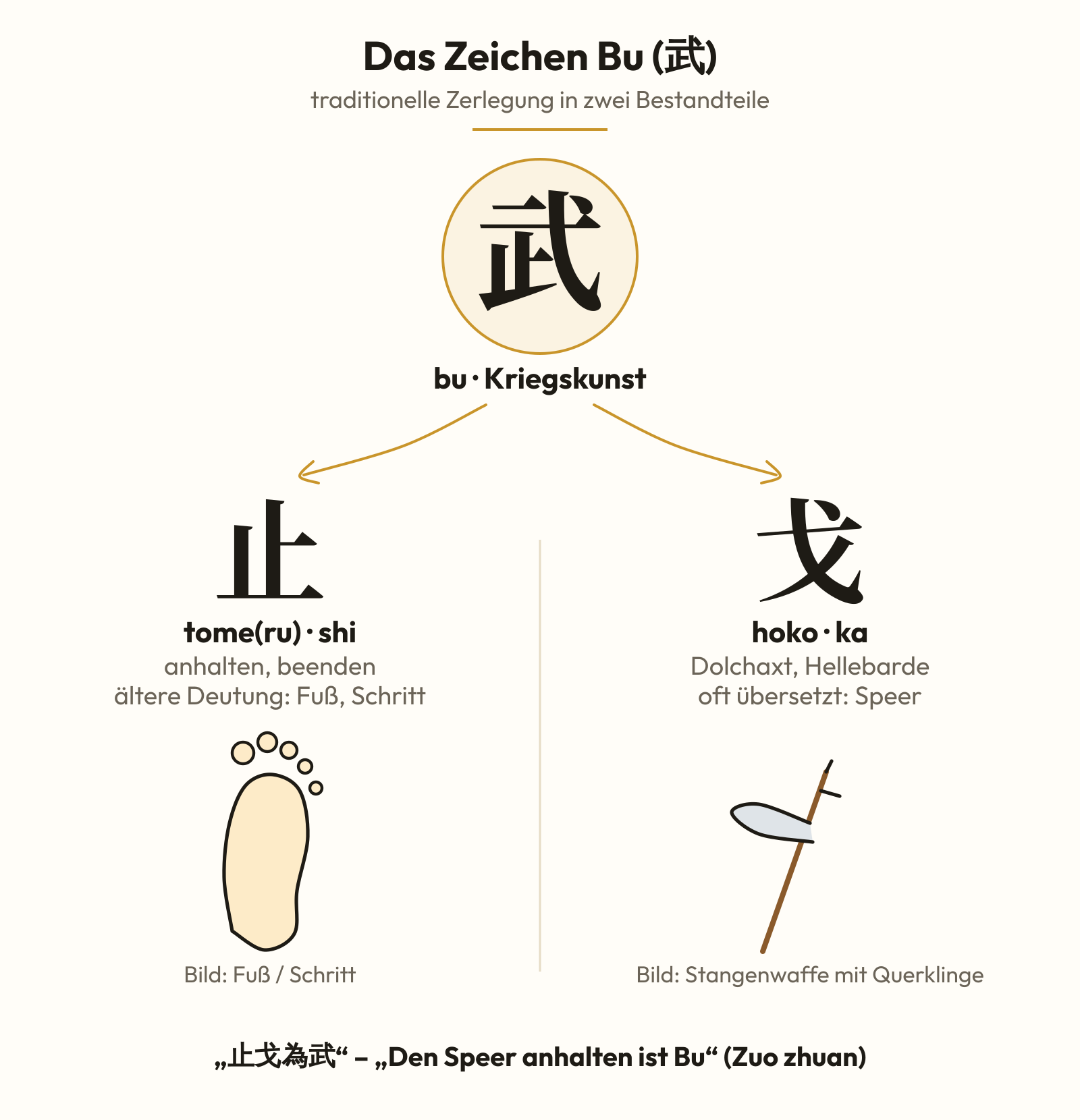
The character 武 is traditionally broken down into two components: 止 and 戈.
- 止 (Jap. tomeru, Sino-Jap. shi): in today’s usage “to stop, to end, to cease”. In the earliest script forms (oracle bones), 止 depicts a foot; the basic meaning “foot, step, to go” is preserved in the older script.
- 戈 (Jap. hoko, Sino-Jap. ka): an ancient Chinese pole weapon with a transverse blade, usually called “dagger-axe” or “halberd” in English, often simplified as “spear”.
Two readings
The classical reading: stopping the spear. In the Zuo zhuan (左傳), a commentary on the Spring and Autumn Annals, King Zhuang of Chu (reigned 613–591 BC) is quoted after the Battle of Bi (597 BC) with the sentence: “止戈為武” – “Stopping the spear is Bu.” There he refuses to build a victory monument from the corpses of his enemies and names seven tasks of Bu, including suppressing violence, putting away weapons and giving peace to the people. The dictionary Shuowen jiezi (c. 100 AD) adopted this explanation. In this reading, Bu does not mean fighting itself, but ending or preventing violence.
The palaeographic reading: marching out with the weapon. Starting from the basic meaning “foot” for 止, many script scholars read 武 originally as “marching with the weapon” or “setting out with the weapon” – an image of a campaign or a display of military power. In this view, the explanation in the Zuo zhuan is a later, ethically motivated interpretation. Which reading reflects the original formation of the character is judged differently in research; both are widespread in the literature.
The character 道 (dō)
道 (Jap. michi, Sino-Jap. dō, Chin. dào) means “way, road” and figuratively “method, teaching, path of life”. The character contains the element 辶 (to go, to be on the move) and 首 (head). In Chinese thought it is the central concept of Daoism (see Dao). In Japan the suffix -dō denotes an art understood as a lifelong path of practice, such as Sadō (way of tea) or Shodō (calligraphy). From the end of the 19th and the beginning of the 20th century, many martial arts were renamed from -jutsu (“technique”) to -dō , for example Jūjutsu to Jūdō or Karate-jutsu to Karate-dō. This brought the educational and character-building side to the fore.
Way of not fighting?
The reading “stopping the spear” is often taken up in modern Budō literature to describe the ideal of avoiding or ending conflicts rather than seeking them (on initiative and timing, see Sen – initiative and timing).
The ideal of Bunbu Ryōdō also links Bu with education and order, placing it in a civil framework. A different emphasis appears with Miyamoto Musashi, whose name itself contains the character 武 (武蔵): in the Go Rin no Sho winning the fight is at the centre, understood as a strategy that can be transferred to all areas of life.
Assessment
The translation “way of the warrior” is neither entirely wrong nor complete: historically, Bu covers war and combat, but was interpreted early on as a mandate to end violence. Whether the character is read as “setting out with the weapon” or as “stopping the weapon” is partly a question of etymology and partly a question of ethics. For the understanding of modern Budō, the second, normative reading has become formative; it should not, however, be passed off as an established etymology. A more accurate translation of Budō is therefore “way of the martial art”.
Connection to training
- Kumite and self-defence are understood as an exercise in control: technique is to be mastered, not unleashed.
- De-escalation, distance and awareness (cf. Zanshin) belong to the martial art just as much as striking and punching techniques.
- Etiquette in the Dōjō (see Etiquette in the Dōjō) emphasises respect for partners, who are not opponents in training.
Sources
- Chinese Text Project: Zuo zhuan, Herzog Xuan (Originaltext mit 止戈為武, 12. Jahr)
- Chinese Text Project: Shuowen jiezi, Abschnitt 戈 (Eintrag 武)
- Minoru Kiyota: Kendo. Its Philosophy, History and Means to Personal Growth. Kegan Paul International, London 1995, S. 15.
- Kenneth G. Henshall: A Guide to Remembering Japanese Characters. Tuttle, Rutland/Tokio 1998, S. 220.
- further reading: Wiktionary, entry 武 (glyph development)
- further reading: Wiktionary, entry 止 (oracle bone form, meaning foot)
- further reading: Wiktionary, entry 道
- Donn F. Draeger: Modern Bujutsu & Budo. Weatherhill, New York/Tokio 1974, S. 11, ISBN 0-8348-0351-8.
- Werner Lind: Budo. Der geistige Weg der Kampfkünste. Nikol, Hamburg 2007, ISBN 978-3-937872-54-4.